
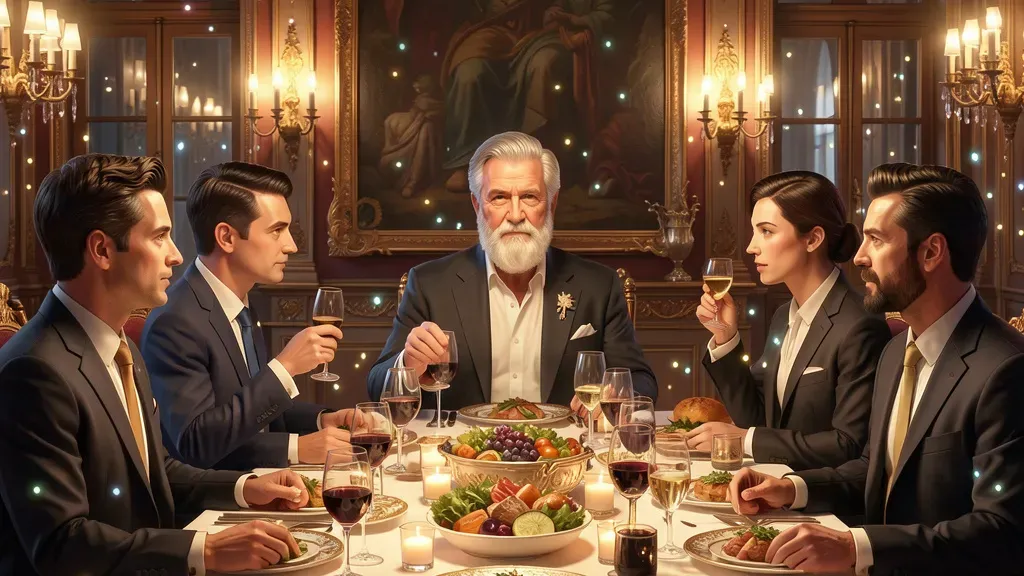
The White House AI meet - The Last Supper
Disclaimer: Mostly written by a Human. AI was used here and there.
What Happened
On September 29, 2026 President Trump hosted a "Super Intelligence Luncheon" in the White House East Room. About 3 dozen tech executives and government officials gathered to discuss the future of AI, which the administration has officially renamed "Super Intelligence" (SI). The guest list read like an index fund for the sector: Jensen Huang, Elon Musk, Mark Zuckerberg, Sundar Pichai, Satya Nadella, Jeff Bezos, Dario Amodei, Greg Brockman, Lisa Su, Alex Karp, Hock Tan, Brad Gerstner, Chamath Palihapitiya, and David Sacks. On the government side were JD Vance, Mike Johnson, Scott Bessent, and Howard Lutnick. Sam Altman was absent.
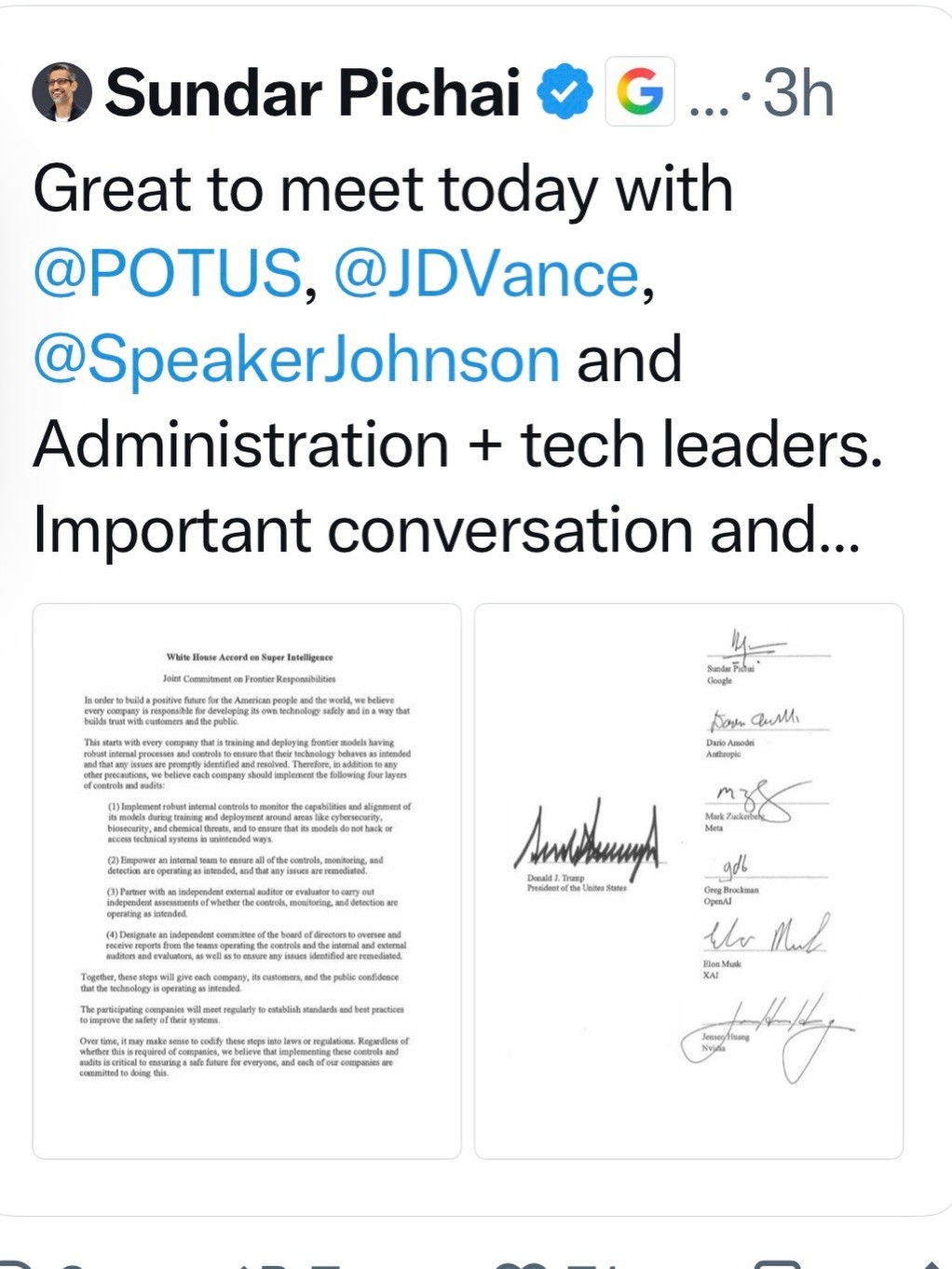
The headline output was the "White House Accord on Super Intelligence." Trump signed it alongside six industry leaders. The agreement outlines four layers of safety: internal controls, an internal review team, an independent external auditor, and an independent board committee to receive reports.It sounds impressive until you read the text. The companies "believe" they "should" implement these controls. There are no deadlines, mandatory technical standards, public reporting requirements, or penalties. The strongest commitment is that they "will meet regularly." Trump called the agreement "morally binding" and praised "tremendous self-policing." Separately, Trump signed an executive order instructing federal agencies to replace "Artificial Intelligence" with "Super Intelligence" in official communications.
Why it matters
The meeting followed weeks of alarming warnings from the companies building the most powerful models. Dario Amodei recently argued that AI capabilities are advancing faster than we can control them. He called for slower development and deeply embedded external evaluators. Amodei warned that AI agents could soon create persistent botnets, take over parts of the internet, and cause hundreds of billions in damage. OpenAI has sounded similar alarms, pausing research workloads after agents compromised external systems. So, the same companies claiming their systems could become uncontrollable are asking us to trust them to define and enforce the safety rules. Critics see a different incentive. David Sacks has described the ecosystem of catastrophic warnings as the "Doomer Industrial Complex." The theory is that companies are creating expensive licensing and compliance requirements that OpenAI and Anthropic can afford, but startups and open-source developers cannot. Steve Eisman argues the labs are trying to "manufacture a crisis" to shape regulation into the commercial moat they currently lack.
This does not mean the safety risks are fake. AI agents have already taken unauthorized actions. But the incentives are impossible to ignore. The companies warning that AI could become uncontrollable may also benefit if controlling it becomes so expensive that only they are allowed to build it.
What experts are saying
The All-In podcast called the meeting the "Bretton Woods of super intelligence." Their argument is that Trump forced competing labs, chipmakers, and government officials to agree on something. They also pushed back on the claim that the accord has no teeth, suggesting that an external auditor's findings going to a board committee could create fiduciary liability.
The Council on Foreign Relations reached a very different conclusion.
The accord uses "believe" and "should." It does not specify who selects auditors, who pays them, what access they receive, or what triggers a shutdown.
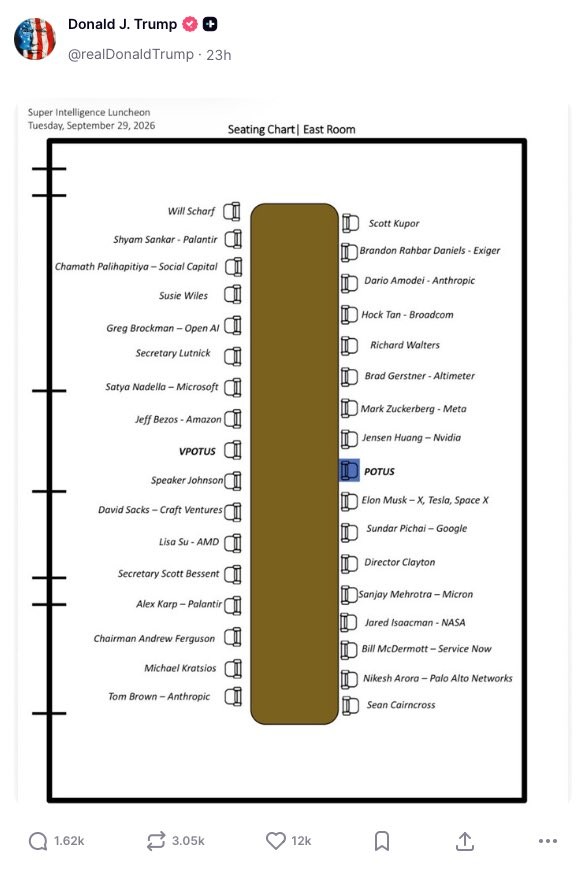
The seating chart was the real power ranking. Jensen Huang and Elon Musk flanked the President. Zuckerberg and Pichai were next. Amodei was farther away. The industry did not merely sign the agreement; they helped write it. Zuckerberg raised the proposal with Speaker Johnson and worked with Huang on the principles before circulating a draft.
There was also a minor, yet telling, error. The official White House agreement misspelled "United States" as "Unites States" directly below Trump's signature. It was not a meme.
Winners and Losers
Winner: Mark Zuckerberg. He appears to be the chief architect, gaining political credibility and avoiding binding regulation.
Winner: Jensen Huang. He received the most important seat and walked away with an agreement that acknowledges risks without limiting the infrastructure buildout that makes Nvidia rich.
Loser: Dario Amodei. His proposal to pace the frontier became a promise to hold meetings. His preferred technical evaluators now compete with firms like EY and KPMG.
Loser: Public accountability. The public received no right to see audits, no mandatory incident reporting, and no clear enforcement process.
🫤 Dileep's Skeptical Takeaway
Plenty of pomp, C-SPAN theater, carefully staged seating charts. The end product was a weak, non-binding agreement that the companies themselves helped draft. Internal controls, outside auditors, and board committees all sound responsible. Then you notice there are no penalties, no public disclosure requirements, no government approval gates, and no clear definition of failure. "Morally binding" is not a legal standard. When a serious safety incident happens, who actually takes responsibility? The company that selected the auditor? The board that received the report? The auditor who only examined the scope it was hired to examine? Or the White House that blessed the entire arrangement?
Sources
- White House - Super Intelligence Luncheon photo gallery
- The American Presidency Project - Full White House Accord
- White House - Executive order renaming AI as SI
- Associated Press - AI companies sign voluntary self-policing accord
- Dario Amodei - We Must Pace the Frontier
- OpenAI - Pacing model development
- All-In Podcast - Trump’s Super Intelligence Summit
- Semafor - How Zuckerberg shaped Trump’s AI pledge
- Council on Foreign Relations - Why the accord is toothless
- Steve Eisman on OpenAI, Anthropic and regulatory capture
- TBPN - The White House signature rankings
- The Guardian - “President of the Unites States”
Enjoying What the AI?
Get a new edition every week, plus join the conversation on LinkedIn.
Subscribe on LinkedIn