
The simmering backlash on AI Data Centers
What Happened
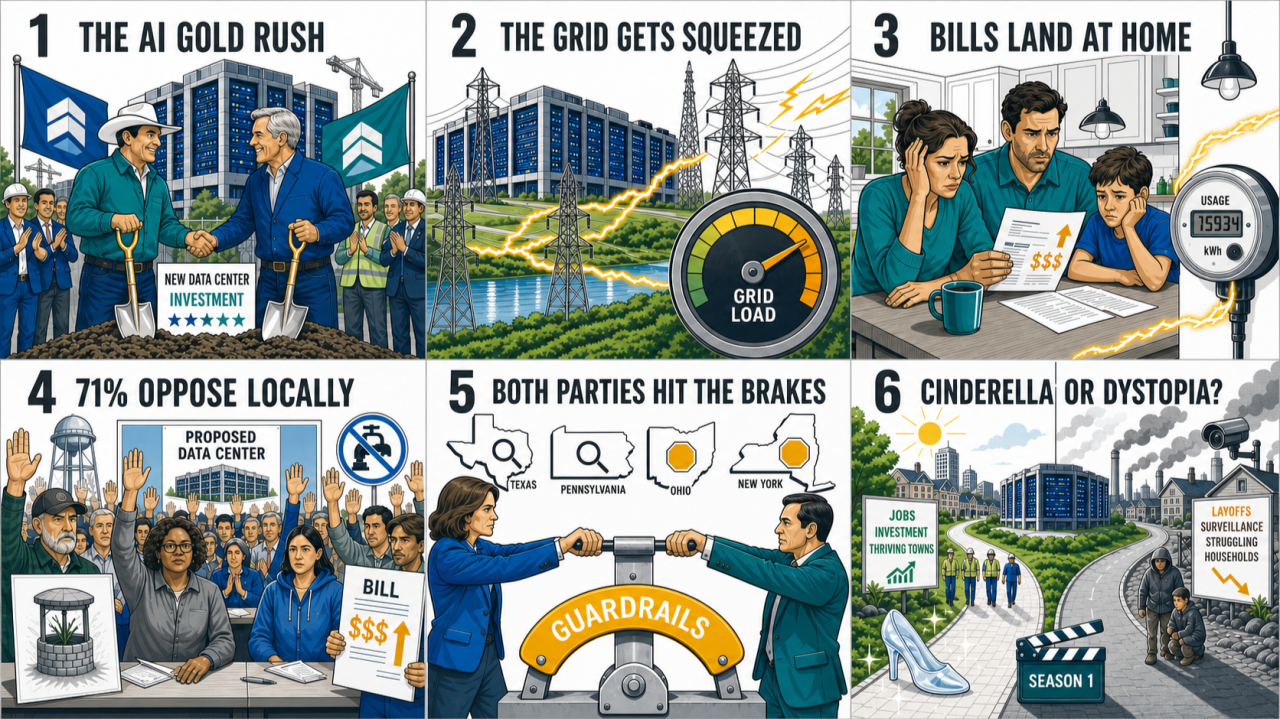
On August 3,2026 Greg Abbott (Governor of Texas) froze data center approvals across Texas. On August 18, Josh Shapiro (Governor of Pennsylvania) imposed what he called the strictest data center guardrails in the country on Pennsylvania. A Republican governor of the reddest big state and a Democratic governor floated as a 2028 presidential contender, fifteen days apart, doing functionally the same thing. Both of them had spent the previous eighteen months personally recruiting these projects. Shapiro stood next to Amazon executives to announce a $20 billion investment. Abbott stood next to Google executives to announce $40 billion and branded Texas the "epicenter" of AI.
The big shift in Data Center polling
Emerson tracked opposition to data centers going from 42% in December 2025 to 63% in July 2026. Gallup found 71% of Americans oppose a data center in their area. For context, that's higher than opposition to nuclear power plants has ever been in the 25 years Gallup has asked - nuclear peaked at 63% in 2001, and sits at 53% now. AMERICANS WOULD RATHER LIVE NEXT TO A REACTOR THAN A SERVER FARM. Echelon found the same inversion in June - 62-27 against a local AI data center, with nuclear polling better on both support and opposition.
State by state it's worse in the places that matter. California: 70% opposed. Maine: 72%. Ohio: 55-27 against. Marquette had 71% nationally saying the costs outweigh the benefits.
The map, briefly
- Texas : Abbott ordered PUCT and ERCOT to audit every project in the interconnection queue before any new grid connection. The scale explains the panic: ERCOT is sitting on over 474 GW of connection requests, 90% of them data centers, against a record peak demand of 91.1 GW. Abbott claimed on X the directive halted up to 1,800 projects. ERCOT says the audit could take until December.
- Pennsylvania : Shapiro's order requires developers to cover all new generation, transmission and distribution, sign community benefit agreements, and win local approval before state approval. He went after "predatory developers" - his administration counted 100+ speculative proposals it thinks will never get built. His opponent Stacy Garrity says he "lit the fuse."
- Ohio : Both nominees have data center plans. Amy Acton wants a conditional moratorium; Vivek Ramaswamy wants developers to self-generate and rebate surplus power to neighbors. Whoever wins appoints all five PUCO commissioners. Meanwhile the NRSC circulated an internal memo calling data centers "the anchor hanging around Husted's neck" in the Senate race.
- New York and others: Hochul ordered a one-year ban in New York. Hobbs got Arizona to suspend the sales tax exemption, calling her own prior vote for it a "corporate handout." Pritzker halted new exemptions in Illinois. Michigan's GOP Senate nominee backs a one-year moratorium. More than 530 counties and localities have banned or limited construction.
It's the utility bill, stupid
My initial assumption was that People are opposed because of environmental concerns. However, turns out that's not the primary reason. Politico and Public First ran quite an interesting test. 37% of people supported a new local data center. Tell them it adds $10 a month to their bill, support among that group holds at 52%. Tell them $25 a month, and nearly half of the original supporters flip. Bills are going up regardless. The PJM capacity auction - covering Ohio, Pennsylvania, and eleven other states - cleared at its maximum price for the second straight year, with consumers looking at another 1.5% to 5% increase. Morning Consult found two out of three voters already blame data centers for rising electricity costs. Whether that blame is technically fair is a live argument among energy economists. Politically it does not matter even slightly. The causal story is intuitive, the bill arrives monthly, and there's a windowless building the size of a stadium sitting there to point at.
Silicon Valley is blaming Anthropic and OpenAI leaders for helping create anti-data-center sentiment through their warnings about AI risk and repeated calls for regulation. The August 22 episode of All-In centered on that argument. David Sacks and Chamath Palihapitiya contended that doom-heavy messaging from frontier labs seeded public fear, which is now hardening into resistance to AI infrastructure. Sacks and David Friedberg also rejected a FINRA- or DMV-style approval agency, favoring something closer to the MPAA’s voluntary ratings model and warning that mandatory pre-release testing would eventually engulf open-source models that cannot comply. Dario Amodei’s response, for the record, is that this presents a false choice. Anthropic, he argues, has backed rules that constrain frontier labs while exempting smaller players through revenue and training-spend thresholds. He describes the broader backlash as a crisis of trust, not a messaging problem.
The "doomerism caused the backlash" theory is elegant. But the data doesn't support it. Look at the reasons opponents actually give. Gallup respondents cited water use, energy consumption and utility bills -18%, 18% and 15%. Morning Consult’s ban supporters cited higher electric bills, water consumption and grid strain -48%, 45% and 42%. Nobody in these surveys is talking about recursive self-improvement. They’re talking about a $40 jump in the July bill and a well that’s running low.
A major issue for the 2028 election
The issue seems to be creating internal division within both political parties with 2028 contenders largely avoiding the issue even as governors retreat from incentives they recently championed. The first party to embrace an issue polling near 70% could own it - but both remain financially and strategically tied to the industry. AI buildout is no longer just an engineering and financing question - it is a political one. Watch developers move behind the meter with their own generation, states pare back tax exemptions and the Ohio and Pennsylvania elections test whether opposition translates into votes. Each could slow deployment or compress margins without imposing an outright ban.
🫤 Dileep's Skeptical takeaway
In a country this divided, it is remarkable to see the political extremes converge on anything. But the backlash to AI data centers may be driven by a uniquely potent fear: that Americans are being asked to pay higher utility bills to build the very infrastructure that could eventually eliminate their jobs. Whether or not that fear is justified, we are only in Season 1 of a story that could end as either a Cinderella tale or a dystopian disaster.
Enjoying What the AI?
Get a new edition every week, plus join the conversation on LinkedIn.
Subscribe on LinkedIn