
The meteoric rise and fall of Leopold, a cautionary tale in AI investing
Disclaimer: I am a random guy on LinkedIn, not your Financial Planner or Tax guy. What you read below are my opinions, not professional Stock recommendations.
What Happened
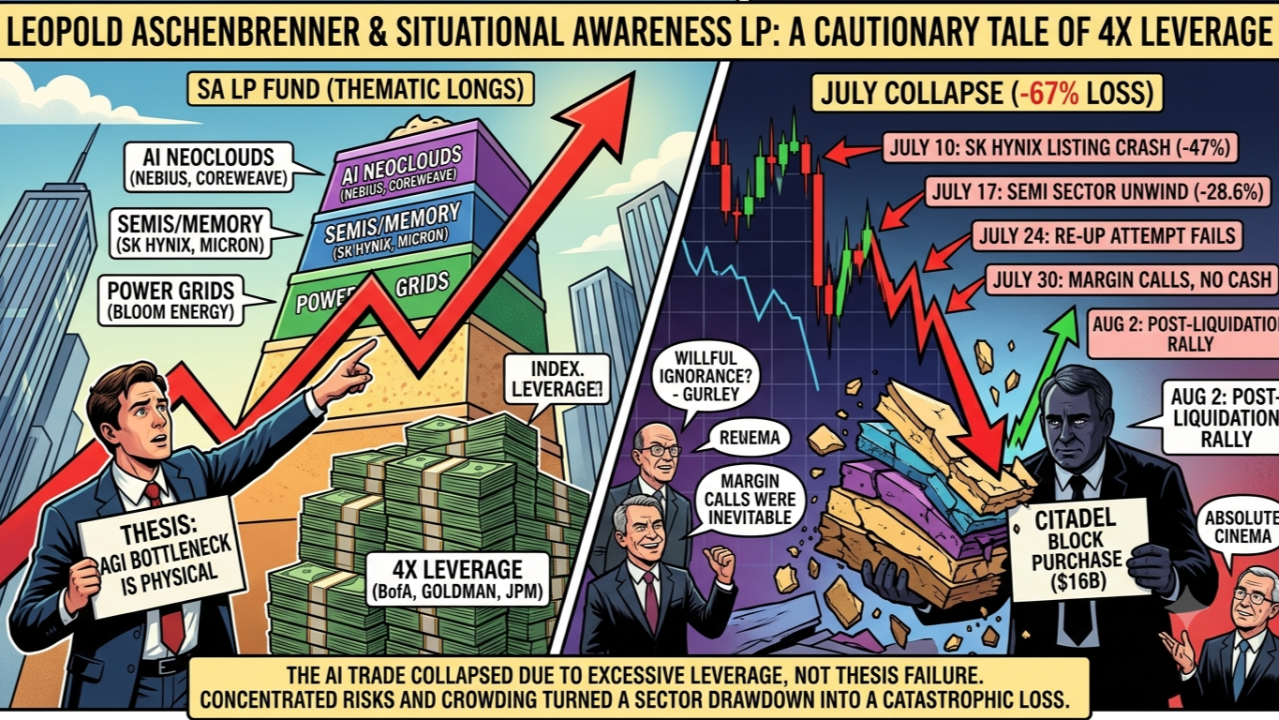
5 weeks ago, in this newsletter, I explained why I skipped the SpaceX IPO and where I put the money instead. I built a position around what I called the AI Layer Cake - energy, chips, neoclouds - and I said out loud that I was pairing my own thesis with the institutional positions of Leopold Aschenbrenner and his fund, Situational Awareness LP.
This was not for hobby. I actually bought non-trivial positions in Nebius, CoreWeave, Riot, URA and QTUM. Also PLTR. On July 30, Aschenbrenner's fund sold its entire public equity book - longs, shorts, everything - to Ken Griffin's Citadel in a single block, at a discount, because three prime brokers had margin called him and he had nothing left to post. Assets went from roughly $45 billion at the start of July to about $10 billion by month end. Reported loss: around 67% in four weeks. This is a fund that had returned 439% net in the first half of 2026 and better than 1,000% cumulative since launching in July 2024.
The Math
Leopold's thesis was not wrong. His argument - the bottleneck to AGI is physical, not algorithmic; it's power grids, memory, and specialized data centers - is the same argument I made in the June edition. Nothing in July disproved it. Hyperscaler capex didn't get cancelled. Compute demand didn't evaporate.
What killed him was a fundamental investing error: approximately 4x leverage. 400% on a concentrated book of high-beta semis, neoclouds and power names, financed by Bank of America, Goldman Sachs and JPMorgan.
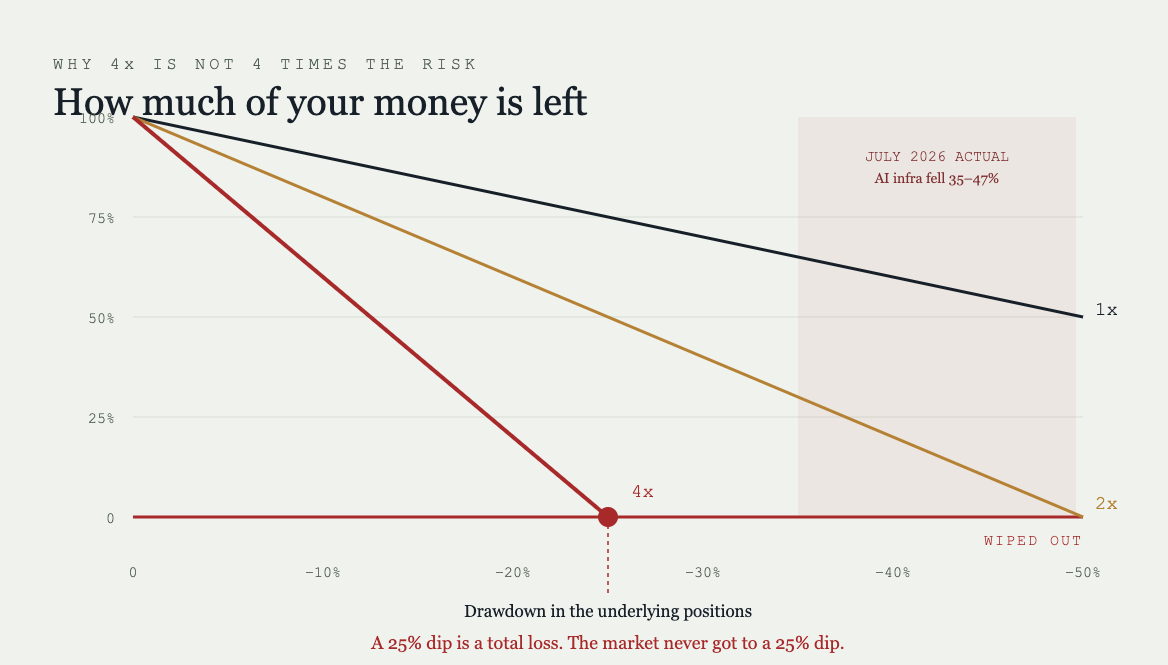
Look at where the red line lands. At 4x, a 25% drawdown in your positions is a total loss of your money. The market never even got to a 25% drawdown. He was gone well before that.
The chain of events, in order:
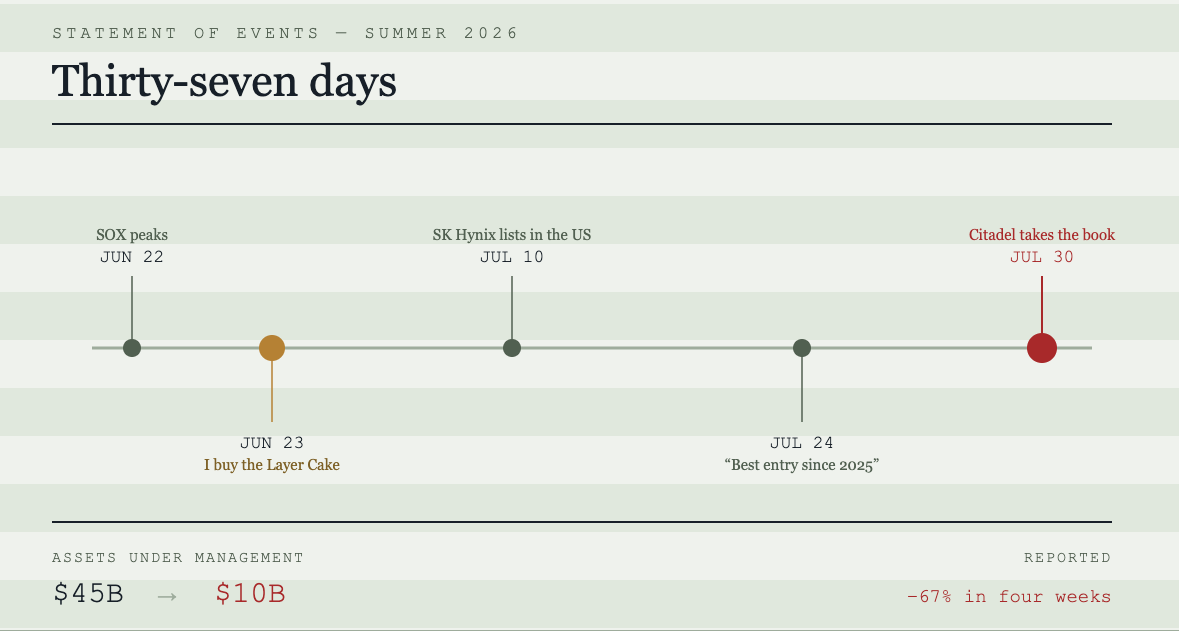
- July 10 — SK Hynix lists in the US. Situational Awareness had gone in with a roughly $7 billion cornerstone indication. The listing sets off an unwind of leveraged Korean equity positions and drags SK Hynix down about 47% from its June peak within weeks.
- Contagion spreads. Nebius, CoreWeave, Micron, Sandisk, Bloom Energy fall 35–47% on the month. The Philadelphia Semiconductor Index drops 28.6% from its June 22 peak. Momentum TMT gets cut in half.
- The hedges fail. The short leg was software - Adobe and friends. Software rallied while AI infra collapsed. Longs and shorts lost simultaneously. There was no hedge, only the appearance of one.
- July 24 - Aschenbrenner writes to investors calling the selloff one of the best entry points since early 2025 and opens for fresh capital on August 1. The money doesn't come.
- July 30 - Margin calls. No cash. The book goes to Citadel, roughly $16 billion of it. What's left is a private vehicle sitting mostly on a ~$5 billion Anthropic stake.
Here is a brutal Plot twist: 2 days after all this drama, the same names ripped. Nebius +26% in a session. CoreWeave +22%. Bloom Energy up nearly 30%. Leopold never got to be right, because leverage collapsed his time horizon to zero.
What others are saying
Wall street elders are having a lot of fun mocking Leopold.
The Kobeissi Letter made the point that the visible number understates it:
Depending on how the book was constructed, the gross securities actually unwound could have run well past $100 billion.
Their read - that the broad market absorbed a shock of that size without breaking - is the part most of the coverage skipped.
Bill Gurley put the diagnosis more bluntly than I would have. His point:
Leopold is obviously brilliant, one in ten thousand rather than merely top 1% — but he was never a student of finance.
Gurley asked ChatGPT to list the 25 greatest investing books ever written, then asked what share of them deal with leverage and tail risk. That subject isn't a footnote in the literature. It's most of it. Being world-class at everything except the most-discussed element of the craft, Gurley argues, takes a kind of willful ignorance.
So nothing surprising happened here. Run a book that levered and this isn't a tail event, it's the base case with a timer on it. Very simple math.
Trading X spent the week on a spicier story. The theory, pushed hardest by @amitisinvesting in a post that cleared 23,000 likes and echoed by @StockSavvyShay:
Citadel talked up surprise-rate-hike fears days before the AI trade cracked, the resulting panic compounded into 50–70% drawdowns in high-beta semis, that forced the most leveraged player in the trade to liquidate near the lows, and then Citadel bought the wreckage cheap. "Absolute cinema," as the post put it. A Wall Street veteran taking out the new kid.
It's a great story. It is also, at this point, a story. None of the reporting I've read - CNBC, WSJ, FT, Bloomberg - establishes intent, coordination, or anything beyond a well-capitalized firm doing what well-capitalized firms do when a forced seller appears. I'd read it as a narrative that's circulating, not a finding. Being the largest buyer when everyone else is a seller is a business model, and it doesn't require a conspiracy to explain.
What I got wrong and what am I doing now
- Crowding is a risk factor I didn't price. When one fund becomes the reference index for a whole theme, thousands of us end up in identical positions without ever coordinating. His 13F was public. People traded off it - I traded off it. That turned an idiosyncratic blowup into a sector-wide event.
- "Follow the smart money" is a position, not a thesis. Nebius and Riot were in my June write-up partly because Aschenbrenner held them. That's outsourcing conviction to someone whose risk structure I couldn't see from the outside.
- I bought one day after the semi peak. June 22 was the top for SOX. I published June 23. That's a reminder about entry timing when a theme has already run 200%.
- Layer 3 has more debt than I gave it credit for. CoreWeave carries roughly $25 billion of it, with interest eating close to half its adjusted EBITDA. Neoclouds are financed businesses. In a credit-spread widening, that matters more than the GPU backlog.
I have already trimmed the names most correlated to the thesis itself - NBIS, CRWV, RIOT, QTUM, and roughly half of PLTR - because the wild 15% a day swings are just not for me. In the tax-advantaged IRA accounts I'm also unwinding the same concentrated growth-tech exposure I've been carrying with Tech ETFs. Parking these in short term investments or cash for now, and will deploy when the AI bubble bursts.
🫤 Dileep's Skeptical Takeaway:
Nothing about the AI trade is making sense to me anymore. The AI stocks go up and down by double digits multiple times a week. Leopold is a cautionary tale in the AI boom and potentially a precursor for more leverage and margin call events to come. Oh, if you are not familiar with Buffet indicator , I will leave you with this to make your own judgement on whether these so called financial gurus shouting every morning on your TV screens are right or wrong.
Buffett Indicator = Total US Stock Market /ValueGross Domestic Product (GDP)
Total US Stock Market Value = $69.15T
Annualized GDP = $31.57T
Buffett Indicator = $69.15T / $31.57T =219%
Enjoying What the AI?
Get a new edition every week, plus join the conversation on LinkedIn.
Subscribe on LinkedIn