
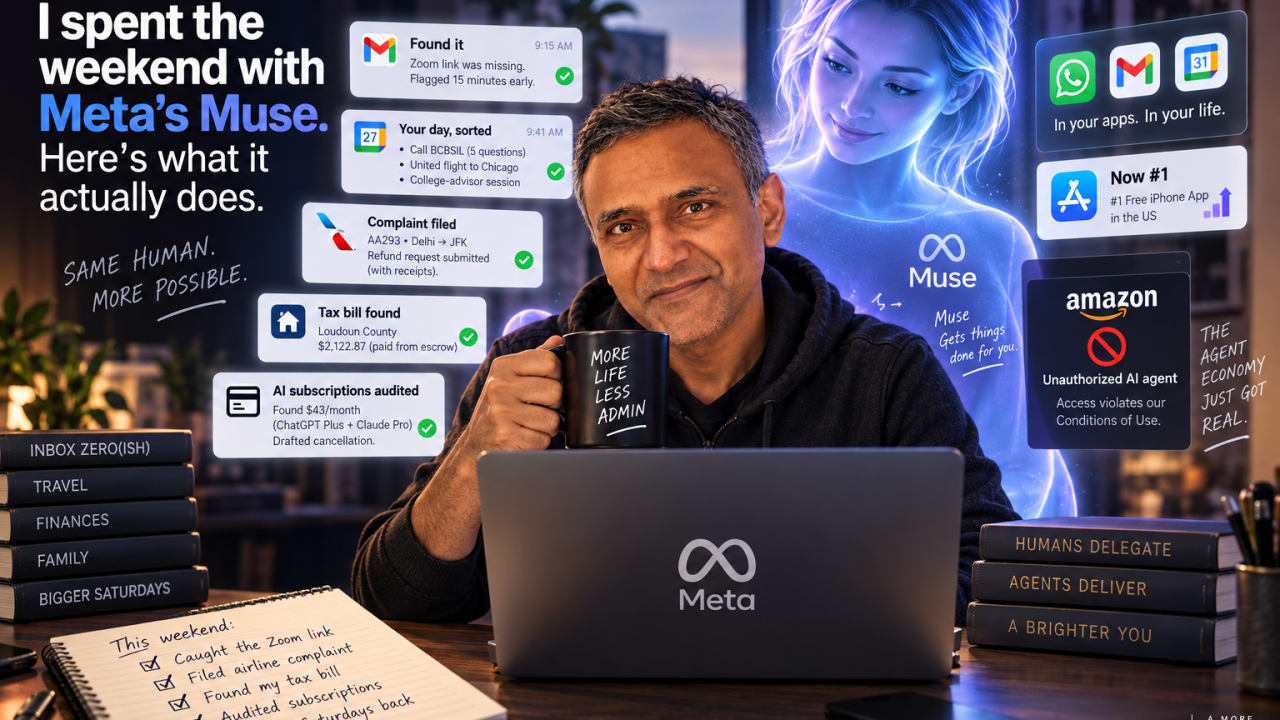
I spent the weekend with Meta Muse, it is shockingly good
Disclaimer: Mostly written by a Human. AI was used here and there.
What Happened
On September 8, Meta launched Muse, a personal AI agent that doesn't just answer questions - it does things. It reads your email, manages your calendar, shops, books travel, files forms, and acts on your behalf across iOS, Android, WhatsApp, and muse.ai. Within days it was the #1 free iPhone app in the US App Store. Also, from a privacy standpoint, just when I thought there was no more data left for me to share with Meta, Muse found a way to do that - in a very useful way.
How Muse works
Muse is kind of like OpenClaw, a personal assistant - except that it is very easy and smooth to setup with nothing to install. You download the app on your phone, it connects to your mailbox, calendar and other apps - and it starts doing all kinds of useful work for you - proactively.
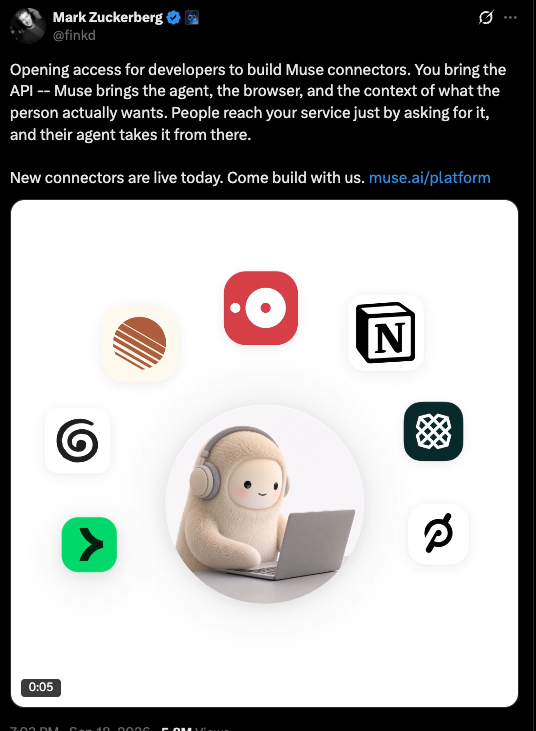
It connects to your accounts, not just your chats. I linked my 3 Gmail accounts and 3 Google Calendars. It searches across all of them at once - no "which inbox was that in" anymore. On September 18, Meta's Mark Zuckerberg opened this up to developers: "You bring the API - Muse brings the agent, the browser, and the context of what the person actually wants." Connectors are live at muse.ai/platform, which means any service can now plug into the agent instead of building its own.
It uses the web like a person when there's no API. When a service doesn't offer a connector, Muse drives a real browser - clicking, filling forms, submitting. Meta says this runs on a secure virtual machine with its own browser, and that credentials you share go into secure storage the agent itself can't see. That's the architecture claim - more on whether I buy it below.
It talks to you where you already are. I connected it to WhatsApp in a couple of steps - no new app to learn, no new habit to build. It just shows up in the thread I'm already in. Meta's growth team clearly understands this: their launch content isn't about the model, it's a thread of "50 prompts to get you started making money, saving money, and improving your life" from Meta's Matt Schlicht. The main pitch is usefulness, in the apps you already open.
It remembers and it reminds. This is the part that separates an agent from a chatbot. Muse keeps working when you're not talking to it - scheduled checks, reminders, follow-ups. It holds context across days: what I asked for, what I decided, what's still open.
My weekend with Muse
It caught a missing Zoom link 15 minutes before my meeting. Monday morning I had a 9:30 AM intro call with a partner team about a potential hardware partnership. At 9:15, Muse flagged that the invite still said "Zoom link to follow" - no link, 15 minutes to go. I found this kind of behavior very different from other Agents which need a lot of TLC. This was an AI assistant reading my calendar, opening the invite, noticing what's missing, and telling me before it becomes a problem.
It ran my day like a chief of staff. A 9:41 AM reminder to call my insurance company about out-of-network benefits for my daughter, with the five questions I'd prepared attached. A heads-up on a 10:15 AM United flight to Chicago on the family calendar. A note about a 7:30 PM college-advisor session. It didn't just list my day - it surfaced the things in my day that needed action. It even prompted me a few hours later that the insurance company working hours were coming to a close - so call them soon.
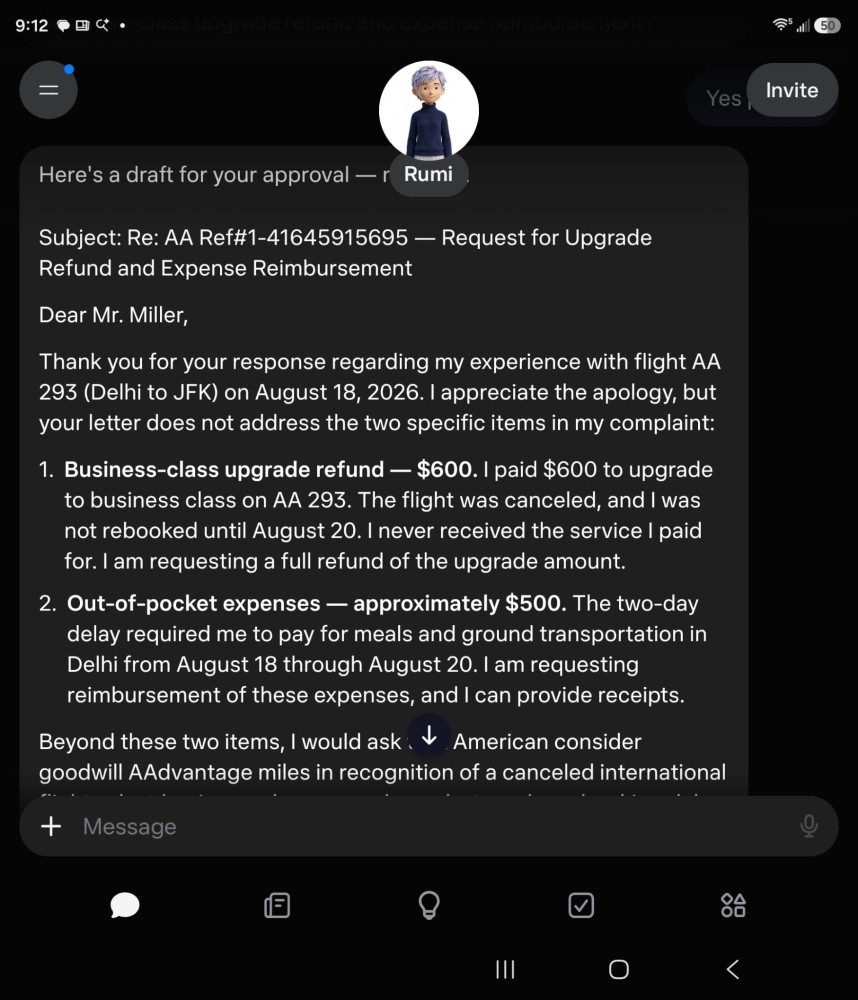
It filed an airline complaint. My American Airlines flight AA 293, Delhi to JFK on August 18 (11:30 PM), was canceled and wasn't rebooked until August 20. Muse drafted the complaint - pulling the confirmation code, ticket number, and prior case reference straight from my booking, plus the ~$500 in meals and transportation from the two-day delay - and filed it on aa.com.
It hunted down a property tax bill. I needed the Loudoun County real estate tax bill for my condo in Ashburn, Virginia. Muse found the first-half 2026 bill - $2,122.87, due June 5 — confirmed it had been paid from escrow on May 20 through my servicer Carrington, and flagged that the December second-half bill still needs forwarding when it arrives.
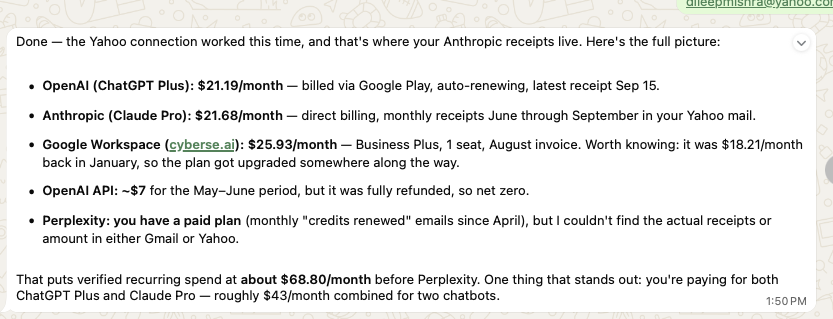
It audited my AI subscriptions. I had it scour every email inbox I own - 3 Gmail accounts plus Yahoo - for every AI subscription receipt it could find. Total damage: ChatGPT Plus and Claude Pro, about $43/month combined. It offered to draft the cancellation for whichever one I use less. (Microsoft's Nicolas Bustamante reported the same experience at larger scale this weekend: his agent saved him $200 canceling services he no longer needed.)
Amazon blocked Muse
On Sunday night, Amazon cut Muse off from shopping on Amazon.com - users saw a popup saying "unauthorized AI agent" access violates its Conditions of Use. Amazon's stated reasons: Meta never disclosed the access, the agent doesn't identify itself, and it appears to capture and store customer credentials. Meta's counter: the agent has no visibility into passwords or payment methods; credentials sit in secure storage. Note the irony: Amazon products have been purchasable inside Facebook and Instagram since 2023, and Meta signed a multibillion-dollar AWS deal in April. Looks like Amazon learned from August, when its hacking-style claims against Perplexity's Comet browser failed in court - this time it's enforcing via contract, not CFAA. Expect every major commerce site to write an "unauthorized AI agent" clause this quarter.
The trust model is the product. An agent that files complaints, moves through your inboxes, and acts on your calendar is an agent holding the keys to your life. Meta claims the agent can't see your passwords, credentials sit in secure storage. But I don't know what's in the VM, who holds the keys, what the audit trail looks like, what happens when the agent is tricked. None of that is public. Which is why the Amazon block matters - it's the first corporate shot in what will be a long fight over exactly this question: who holds the credentials when an agent acts, and who gets to decide?
🫤 Dileep's Skeptical takeaway
Muse is all of a sudden the hottest thing in AI. The Meta stock was up 10%+ yesterday. Their playbook is so obvious now it's funny - they are just going to ride on the rich data and context of our lives to give us an AI assistant so useful we can't ignore. Yes, there are huge implications for privacy, but this is going to make the already beleaguered OpenAI and Anthropic teams sweat. They are not using a cutting edge frontier model - their RoI is not dependent on people paying for tokens. And with personal wearables like Meta Glasses, it is on;y a matter of time before they own the entire Personal AI consumer ecosystem.
Sources:
- Mark Zuckerberg (@finkd) – Muse developer connectors announcement (https://x.com/finkd/status/2101084678640066765)
- Matt Schlicht (@MattPRD) – "50 prompts" thread for new Muse users (https://x.com/MattPRD/status/2101361194183614611)
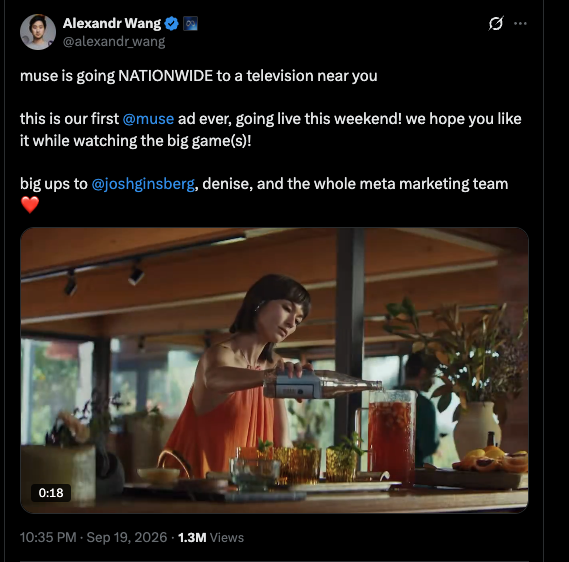
- Alexandr Wang (@alexandr_wang) – first national Muse TV ad (https://x.com/alexandr_wang/status/2101500560050684401)
- Nicolas Bustamante (@nicbstme) – "Everything becomes B2A: business to agents" (https://x.com/nicbstme/status/2101738613851803877)
- GeekWire – "Amazon blocks Meta's Muse AI assistant in new standoff over agentic shopping" (https://www.geekwire.com/2026/amazon-blocks-metas-muse-ai-assistant-in-new-standoff-over-agentic-shopping/)
- Gizmodo – "Amazon Brings Down the Hammer on Meta's Muse AI Agent" (https://gizmodo.com/amazon-brings-down-the-hammer-on-metas-muse-ai-agent-2000814878)
Enjoying What the AI?
Get a new edition every week, plus join the conversation on LinkedIn.
Subscribe on LinkedIn