
5 trending AI terms you need to know in August 2026
Disclaimer: This article was conceptualized and written by a Human, but AI helped with edits, citations and visuals.
What Happened
In the last few months, we are seeing a trend where the Model quality itself is becoming a given. Yes - Fable 5 and GPT 5.6 are better, but not phenomenally better than Opus 5 and some of the latest models from the Chinese labs (e.g. Kimi K3, DeepSeek v4 Flash). We seem to be moving beyond the "engine" and focusing on other criteria - like the interior, climate control, etc. The trends below have nothing to do with making models smarter. They're about what you build around the model. The model is not the product. The thing you wrap around it is.
Here are the 5 words you'll hear in every AI meeting for the rest of the year.
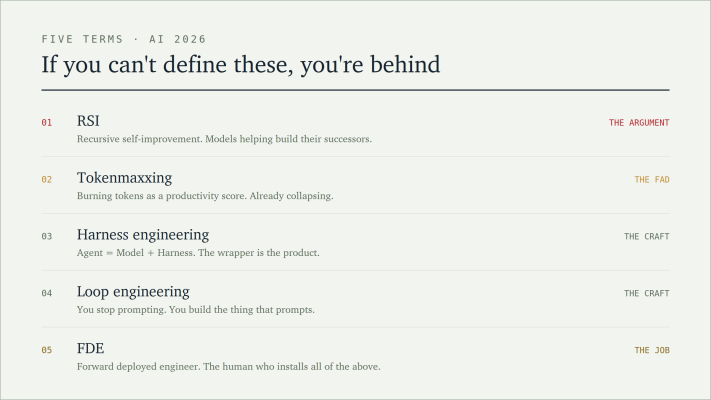
1. RSI - Recursive Self-Improvement
What it means: AI systems that meaningfully help build the next generation of AI systems.
Why it's suddenly everywhere: On February 5, 2026, OpenAI shipped GPT-5.3-Codex and wrote in the release notes that early versions of the model had been instrumental in creating itself - debugging training runs, managing deployment, diagnosing evaluation failures. That was the first time a frontier lab said out loud that its model had materially worked on its own successor. Matt Shumer's essay "Something Big Is Happening" went viral four days later and the term escaped containment.
What's actually true: The real version is already running. DeepMind's AlphaEvolve has proposed chip-blueprint rewrites and shaved about a point off Gemini's own training time. There's now an ICLR 2026 workshop devoted to it. A July survey of 1,250 arXiv papers drew the useful line: bounded self-refinement — convergent, measurable, already industrial practice — is real and shipping. Open-ended RSI, the intelligence-explosion version, is still fenced in by grounding requirements, model collapse dynamics, and plain compute limits on every axis anyone has measured.
Why I care, specifically: The Cloud Security Alliance published a piece in June arguing that the security threshold arrives well before the scary version does. Once models materially participate in building their successors, you get a new supply chain — new high-value targets, new channels for vulnerabilities to propagate into the next generation, new uplift mechanisms. The 2026 International AI Safety Report, written by 100-plus independent experts, lists loss of control via RSI among the most consequential national-security-level risks.
2. Tokenmaxxing
What it means: Burning as many tokens as possible and treating that number as proof you're productive. The "-maxxing" suffix is borrowed from looksmaxxing and sleepmaxxing, which should have been the first warning.
How it played out: In early 2026 this jumped from an X joke into actual HR dashboards. Companies built internal leaderboards ranking engineers by Claude and Codex consumption. People earned titles like Token Legend and Cache Wizard. Atlassian handed R&D staff monthly AI wallets running $500 to $2,000 across four tools. Token budgets became a perk category alongside stock options.Then it fell over, fast. Amazon deprecated its internal leaderboard. Meta's token-tracking culture became the cautionary tale people cite. Microsoft's Jay Parikh told staff outright that tokenmaxxing is not the goal, handed divisions actual budget targets, and made a cheaper model the internal default. By late May, Fortune was already writing the obituary.
The part worth keeping: IBM's replacement framing is valuemaxxing, and their warning is sharper than the original trend. Organizations that panic about token spend start cutting the wrong things. Strip out oversized tool catalogs and stale context and you're fine. Keep cutting and you start deleting task descriptions, business constraints, architectural context — the information that made the thing work. The costs don't disappear. They move into retries, extra reasoning, validation cycles, and human rework. You get to celebrate a lower input-token count while paying for the same complexity somewhere less visible.
Spoiler: this is the shortest-lived term on the list. Learn it so you can recognize the behavior, not because anyone will be bragging about it at Christmas.
3. Harness engineering
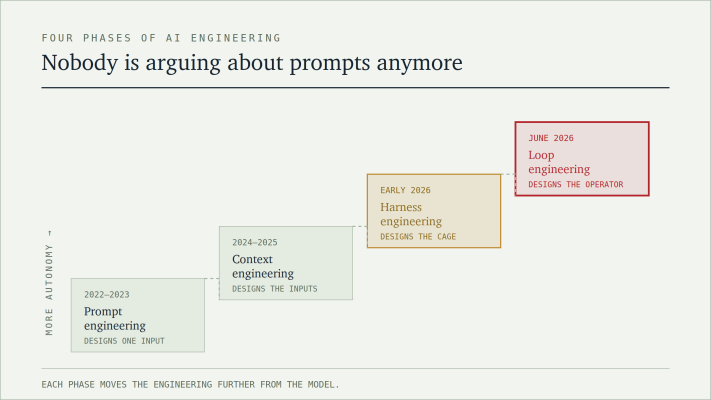
What it means: The equation that took over 2026 is Agent = Model + Harness. The harness is everything around the model — tool orchestration, verification loops, memory, guardrails, observability. Harness engineering is the discipline of building it.
Where it came from: Ryan Lopopolo at OpenAI gave it a formal definition in a February 11 post, written off the back of shipping a production application with zero manually written lines of code. He'd deliberately refused to write any code himself so the agent had to do the whole job. Mitchell Hashimoto popularized the operating principle: any time you find an agent making a mistake, engineer a solution so it can never make that mistake again. Usually the solution is a better harness.
The distinction that makes it click: Telling an agent "follow our coding standards" in a prompt is not the same as wiring a linter that blocks the PR when standards are violated. The first is probabilistic compliance. The second is a deterministic constraint. Harness engineering is the discipline of converting the first into the second, over and over.
Birgitta Böckeler's framing is the one I've found most useful in practice - think of a harness as feedforward guides plus feedback sensors, and split your controls into computational ones (linters, tests, type checkers) and inferential ones (LLM-as-judge). She argues harnessability should become a first-class criterion in architecture decisions, which is a genuinely new idea about how to choose a tech stack.
Why this is a security term, not just an engineering one: Apiiro found AI-generated code was introducing more than 10,000 new security findings per month by mid-2025, roughly ten times the December 2024 rate. That number doesn't get fixed by a smarter model. It gets fixed by a harness that refuses to merge. Frontier labs build the inner harness — native tool calling, base safety layers. The outer harness, the one built around your actual environment and your actual data, is yours to build, and it's where your moat is.
4. Loop engineering
What it means: You stop being the person who types the next instruction, and you build the system that decides the next instruction for you.
Where it came from: June 2026. Addy Osmani, an engineering lead at Google Chrome, pulled together ideas from Anthropic's Boris Cherny and Peter Steinberger into a framing that spread within weeks. Steinberger's definition is the cleanest — replace yourself as the person prompting the agent, and design the system that does it instead. Cherny's version is four words: he doesn't prompt Claude anymore.
How it differs from harness engineering, since everyone confuses these: the harness is the cage the agent operates inside. The loop is the thing that decides when to send the agent in, what counts as done, and what happens when it fails. A harness makes one run safe. A loop makes a thousand runs unattended.
A loop needs four parts: a trigger (what kicks it off), a verifier (what checks the work), state (what it remembers between runs), and stop rules (when it gives up). If you can't name all four for a workflow, you don't have a loop yet, you have a cron job with anxiety.
The caveat, which came from a working FDE rather than a vendor: don't start with a loop. Find one recurring workflow where the decision logic is genuinely ambiguous at runtime — something a script can't pre-specify. Run it manually with an agent a few times. Watch where it fails. Then build the loop. Most of what gets called loop engineering should have been a bash script, and the people building this stuff for a living say so more often than the people selling it.
5. FDE - Forward Deployed Engineer
What it means: An engineer embedded inside a customer's company who scopes, builds, and ships an AI system end to end, in their actual environment, against their actual messy data - and owns whether it works.
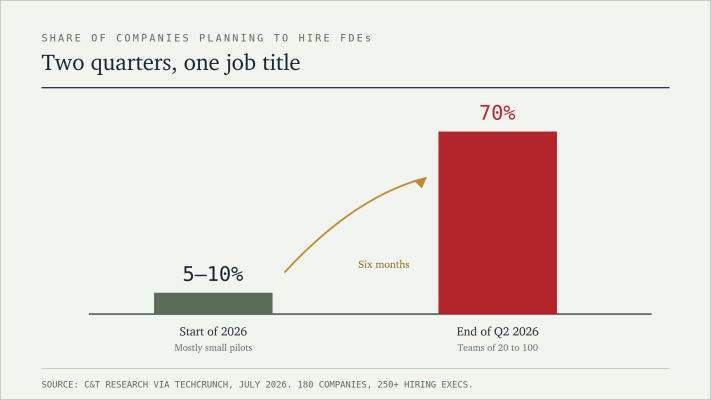
Where it came from: Palantir made it mainstream it in the early 2010s. a16z called it the hottest job in startups in mid-2025. Job listings rose roughly 800% between January and September 2025, and more than 1,000% year over year into early 2026. But the number that stopped me came from TechCrunch two weeks ago, drawn from interviews with 250-plus hiring executives across 180 companies: at the start of 2026, 5 to 10% of companies were planning to hire FDEs, mostly for small pilots. By the end of Q2 it was 70%, with the big consulting firms saying they need ten times the FDE headcount and teams of 20 to 100 people. One recruiter described enterprises hiring in the middle of summer, at a speed he'd never seen.
Comp bands cluster at $300K to $550K total, with principal roles at frontier labs clearing seven figures. New York has overtaken San Francisco as the main hub, roughly 35% of postings against San Francisco's 11%. OpenAI stood up an entire initiative called The Deployment Company. Anthropic, Databricks, Ramp, Adobe, Decagon and a long tail of Series A startups are all hiring for it.
Why the role exists at all: an MIT NANDA study found 95% of enterprise AI pilots produced little or no measurable impact on profit. The gap between a demo that impresses a VP and a system that survives contact with a real company's data is enormous, and no amount of model capability closes it. Only a person sitting inside the building closes it. The postings describe roughly 60% customer-facing time, 30% deployment-specific code, and the rest everything else. Read that split again if you're a strong engineer who assumed this was a coding job.
🫤 Dileep's Skeptical Takeaway:
The bottleneck in AI is not just in the energy and the compute needed. For practical , real RoI, we need working Agents which can be controlled and monitored at scale. Harness engineering, loop engineering, and the FDE boom are all the same confession in different clothes: the model is a commodity and the wrapper is the product. If you take one thing from this: the real impactful work in AI right now is the dry deployment work, done close to a customer, ensuring their business outcomes are being met faster and cheaper. AI just happens to be the means to get there.
Sources
RSI — Recursive Self-Improvement
- Is Recursive Self-Improvement Really Here? — Communications of the ACM, July 2026. Covers the GPT-5.3-Codex release notes and the Solar-Lezama bottleneck argument.
- Recursive Self-Improvement Edges Closer In AI Labs — IEEE Spectrum, May 2026. Source of the Jeff Clune and Dean Ball quotes.
- Recursive Self-Improvement in AI: From Bounded Self-Refinement to Autonomous Research Loops — arXiv, July 2026. The 1,250-paper survey.
- Recursive Self-Improvement Signals: Security Implications — Cloud Security Alliance, June 2026. The supply-chain argument.
- ICLR 2026 Workshop on AI with Recursive Self-Improvement
- RSI in the Wild — Adnan Masood, June 2026. AlphaEvolve details.
Tokenmaxxing
- What Is Tokenmaxxing? The AI Workplace Trend Explained — Built In, April 2026.
- Tokenmaxxing is dead, long live valuemaxxing — IBM, July 2026. The cost-displacement argument.
- Productivity Metric or Vanity Trap? — Trending Topics, April 2026.
- What Is Tokenmaxxing? AI Workplace Trend Explained — explainx.ai. Leaderboard titles, Amazon and Meta.
- Tokenmaxxing Desk — running tracker of AI token spend; source of the Microsoft and Atlassian details.
- The Productivity Paradox of Generative AI Consumption — Adnan Masood, April 2026.
Harness engineering
- Harness engineering: leveraging Codex in an agent-first world — OpenAI (Ryan Lopopolo), 11 February 2026. The primary text.
- My AI Adoption Journey — Mitchell Hashimoto, 5 February 2026. Where the term was coined (see "Engineer the Harness").
- Harness Engineering — Birgitta Böckeler on martinfowler.com. The guides-and-sensors taxonomy.
- Extreme Harness Engineering for Token Billionaires — Latent Space podcast with Ryan Lopopolo, 7 April 2026. (Apple Podcasts)
- Harness Engineering for AI Coding Agents — Augment Code. Deterministic vs. probabilistic constraints; cites the Apiiro security findings.
- Harness Engineering — Faros AI. The five layers and the phase model.
- awesome-harness-engineering — running link collection.
Loop engineering
- Loop Engineering — Addy Osmani, 7 June 2026. The essay that named it. (Substack · O'Reilly Radar repost)
- Loop Engineering Emerges as Developers Put AI Coding Agents on Repeat — ADTmag, 1 July 2026.
- What is Loop Engineering? How is it different than Harness Engineering? — Akshay Kokane, July 2026. Source of the "don't start with a loop" advice.
- What Is Loop Engineering? Beyond Prompt Engineering in 2026 — explainx.ai.
- From Writing Prompts to Designing Loops — Gerald Chen. A useful dissent that disputes placing loop above harness.
FDE — Forward Deployed Engineer
- Trading Margin for Moat: Why the Forward Deployed Engineer Is the Hottest Job in Startups — a16z (Joe Schmidt), June 2025. The services-led-growth thesis.
- Forward-deployed engineers are the AI industry's latest talent obsession — TechCrunch, 30 July 2026. The 5–10% to 70% figure.
- 2026 FDE Hiring Trends: What 1,000 Job Posts Reveal — Perspective AI, June 2026. Comp bands, the 60/30/10 split, hub data.
- What are Forward Deployed Engineers, and why are they so in demand? — The Pragmatic Engineer.
- Introducing the a16z FDE Fellowship — a16z, May 2026.
- MIT report: 95% of generative AI pilots at companies are failing — Fortune coverage of MIT Project NANDA's The GenAI Divide. Note: this study is from 2025, not 2026.
- Forward Deployed Engineering 101 — Kevin Bai, Anthropic and How FDE is done at Kepler — Vinoo Ganesh — AI Engineer talks, July 2026.
Cross-cutting
- The Pragmatic Engineer podcast — the Dex Horthy episode covers context engineering, harness engineering and loop engineering in a single sitting.
Enjoying What the AI?
Get a new edition every week, plus join the conversation on LinkedIn.
Subscribe on LinkedIn